(New York, NY) – “We are some of the luckiest creatives on the planet. As hairdressers, we get to shape more than hair—we shape identity. We create for our clients, inspire fellow artists, and are continuously inspired by each other. That exchange of artistry is at the heart of this story and at the heart of this haircut,” explains Teresa Romero, Creative Director for Sam Villa and Artistic/Education Director for Jose Luis Salon
Like many of you, I spend a great deal of time exploring social media and the global hair landscape, watching what artists are creating both near and far. My personal aesthetic is influenced by creative movements around the world, including Europe, Asia, and beyond—regions where craftsmanship, intention, and design consistently push boundaries. My clients often ask, “What are you seeing globally that could be incredible for me, while still feeling wearable in everyday life?” They want fashion-forward ideas that feel modern, exciting, and authentically theirs.
That curiosity, paired with my own constant search for inspiration, led me to a cut that stopped me in my tracks—the Fairy Cut, a shape emerging out of France with a beautifully intentional point of view. While this French interpretation sparked the look you see here, the roots of the cut reach even further.
Its lineage can be traced to South Korea’s airy techniques used in the Hush Cut, Japan’s see-through layered detailing, and Chinese salon trends that combine micro-layering with fluid slide cutting. Like all things in our craft, the shape evolves as it travels. Variations of the Fairy Cut can be seen across countless social platforms, each influenced by regional artistry and cultural expression—yet it was the expression of the cut featured on the @coiffeurstory Instagram account that truly caught my eye and inspired this particular interpretation.
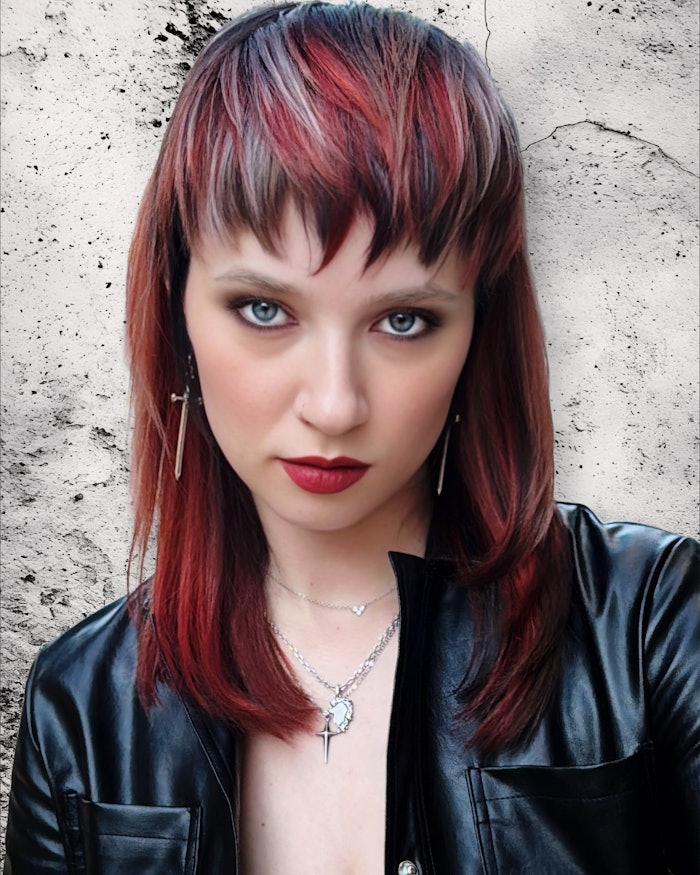
While some in the U.S. may be tempted to compare the Fairy Cut to a mullet, its structure is far more refined and ethereal—evoking a fairy-like lightness. It features a micro-short fringe contrasted with elongated length through the back, complemented by long to minimal layers. The sides are sculpted to open the temple area and remain purposefully disconnected from the back. Often, a soft point is left in front of the ear—an elegant detail that enhances the silhouette.
The top and fringe are layered short and textured, giving the look lift, movement, and airy weightlessness. Visually, the cut appears blended because the transition points follow the head’s natural architecture, allowing seamless flow without technical blending. The impact becomes strongest when the contrast between the short top and sides and the long back is pronounced.
In-studio or behind the chair, the Fairy Cut is beautifully versatile. It works effortlessly with natural texture—air-dried with a curl cream—or, as in this interpretation, worn smooth for a sculptural, modern finish.
This version also incorporates the Calico color trend—an addition crafted to honor the collaborative vision between myself and my client and friend, Julia. The marriage of the Fairy Cut with Calico coloring creates a uniquely wearable expression of her identity. This is the work we should all be doing daily as behind-the-chair identity creators: blending global inspiration with individual storytelling,” explains Romero.
Step-by-Step Overview
- Begin with a thorough assessment of the hair’s natural texture, density, growth patterns, and any previous chemical history. Adjust the following steps accordingly.
- Section the hair from the high point of elevation to just behind the ear, following the natural vertical transition from top and sides into the back.
- Establish the front fringe, then sculpt the sides near the ears—making sure to leave a longer point in front of the ear. Use a Sam Villa Classic Series Shear, it has a traditional semi-offset handle and sculpted finger rings for comfort and control.
- Layer the top and sides short enough to contour close to the head without appearing shaved.
- Following the same sections, use a Sam Villa Signature Series Razor in a crisscross “X” pattern to create internal movement.
- Keep the back long. Shape a square perimeter for weaker hairlines; stronger hairlines can support a round or oval outline. Ultimately, choose what best suits the client.
- Leave the length, or as shown here, incorporate long layers that sit in the lower third of the silhouette.
“What I love most about this haircut is how it reminds me that inspiration is everywhere. It lives in the hands of artists across the world who, just like us, show up each day ready to create,” says Romero. “The Fairy Cut—and its many interpretations—proves that hair is a universal language. When we listen to each other, our work becomes richer, braver, and infinitely more connected. This look will continue trending into 2026 and will likely morph into hybrid versions—because that is the beauty of creativity. It is always old and new at the same time, constantly reinvented, reshaped, and rediscovered. I’m excited to see what comes next. Your clients will appreciate the excitement and versatility of this haircut, along with the future possibilities it provides.”