Artificial intelligence continues to grow and expand, but what does that expansion look like for the beauty professional? Which careers will still offer long-term opportunity in a world increasingly influenced by automation? These are questions professionals, students and parents are asking.
According to Deloitte's 2025 Gen Z and Millennial Survey, 61% of Gen Z worry generative AI will make it harder for younger generations to enter the workforce by automating entry-level jobs. At the same time, 86% believe human skills will become even more valuable.
For more than 100 years, Rizzieri School for Beauty and Wellness (formerly Rizzieri Aveda School), has prepared students for careers in cosmetology, skin care, barbering, manicuring and instructor training. During that time, the industry has continually evolved through new techniques, products, technology and changing guest expectations.
Rizzieri sees artificial intelligence as the next evolution, not a replacement for the professionals who build careers serving people.
Frank Rizzieri, owner and president of Rizzieri School for Beauty and Wellness sees artificial intelligence as the next evolution, not a replacement for the professionals who build careers serving people.
Beauty Launchpad chatted with Frank Rizzieri, how he sees AI in the future of the beauty professional.
Beauty Launchpad: Where do you think beauty professionals can use AI most effectively without losing the personal element that defines the industry?
Frank Rizzieri: AI belongs in the parts of the business that happen before and after the chair, not in the chair itself. It can help a professional research a technique, prep for a consultation, manage a schedule, or handle the marketing and admin work that used to eat into their day. What it cannot do is sit across from a client, look at their face and know what they actually mean when they say "something different, but not too different." That reading only comes from a trained eye and years of listening to people. The professionals who will thrive are the ones who let AI take the busywork off their plate so they have more time and energy for the part of the job a machine will never touch.
BLP: How is trust built between the client and the professional and why do you think it becomes even more valuable in an increasingly AI-driven world?
Rizzieri: Trust usually starts with someone telling a client something they didn't want to hear. You look at a photo they bring in and tell them honestly it won't work on their hair texture, then you give them something that will. Do that enough times and they stop bringing in photos altogether, they just trust you to figure out what's right. That's earned over years, not downloaded in an app. It matters more now because clients walk in having already researched everything online; they've seen every version of the look on their phone before they ever sit down. What they need is a professional who can take all that research and turn it into a result that actually fits their face, their lifestyle and their budget.
BLP: What skills should beauty schools prioritize now to prepare students to work alongside AI rather than compete with it?
Rizzieri: Technical skill still comes first. Nobody hires a stylist because they're good with a chatbot. But once that foundation is there, we're spending more time than we used to on consultation, communication and running a business. Those are the skills AI can't replace and they're also the skills that used to get the least classroom time. A student today needs to know how to read a client in the first ninety seconds of a conversation, how to build a book of loyal guests and how to think like a business owner from day one, because the paperwork and scheduling side of this career is only going to get more automated. We'd rather graduate someone who can do both, master the craft and run the chair like a business. I think the schools that figure this out first are going to set the standard the rest of the industry follows, the same way the good ones always have.
BLP: How has Rizzieri's approach to education evolved as technology becomes a larger part of running a successful business?
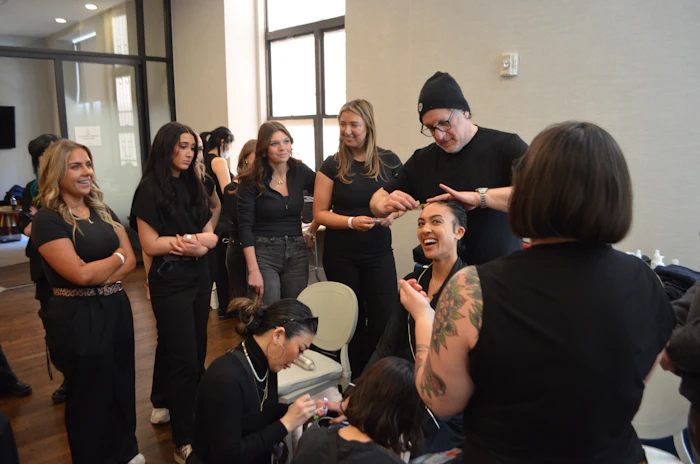
Rizzieri: Rizzieri School for Beauty and Wellness has carried three generations of family leadership through a hundred years of change. Even the name has changed as we've grown. We made that shift ourselves this year. We navigated it when the internet showed up and changed how people found a salon, we navigated it when social media became the new front door for a young stylist's career and AI is just the version we're navigating now. What's actually shifted in the classroom is how much advanced equipment and product technology students touch as part of their hands-on training, not just hear about in a lecture. They're working with tools from Bio-Therapeutic and HydraFacial, learning the science behind Dermalogica and Jan Marini's approach to skin, doing real color and styling work with Goldwell, Davines, Sassoon Connect and R+Co. Ten years ago, that level of technology wasn't part of a first-year curriculum. Now it's standard and I'd expect the same to be true of AI five years from now. We'd rather our students learn how to use it well than watch them figure it out on their own after they graduate.
As conversations about AI continue to reshape education and workforce planning, Rizzieri hopes the beauty industry becomes part of the broader discussion about careers built for the future.